Analysis of 10x Visium invasive ductal carcinoma slice#
In this tutorial, we demonstrate SpaRCL on the analysis of 10x Visium invasive ductal carcinoma stained with fluorescent CD3 antibody slice including
Spatial reconstruction
Relational contrastive learning
Spatial domain identification
Spatial domain annotation
Finding differentially expressed genes
The dataset is available at 10x genomics website (Spatial Gene Expression >> Visium Spatial Gene Expression Fluorescent Demonstration (v1 Chemistry) >> Space Ranger 1.2.0 >> Invasive Ductal Carcinoma Stained With Fluorescent CD3 Antibody).
[1]:
import numpy as np
import pandas as pd
import scanpy as sc
import matplotlib.pyplot as plt

import SpaRCL as rcl
Data loading and preprocessing#
We load the dataset and find top 2000 highly variable genes.
[2]:
adata = sc.read_visium('./data/Invasive Ductal Carcinoma Stained With Fluorescent CD3 Antibody/')
adata.var_names_make_unique()
adata
Variable names are not unique. To make them unique, call `.var_names_make_unique`.
Variable names are not unique. To make them unique, call `.var_names_make_unique`.
[2]:
AnnData object with n_obs × n_vars = 4727 × 36601
    obs: 'in_tissue', 'array_row', 'array_col'
    var: 'gene_ids', 'feature_types', 'genome'
    uns: 'spatial'
    obsm: 'spatial'
[3]:
sc.pp.highly_variable_genes(adata, n_top_genes=2000, flavor='seurat_v3')
Spatial reconstruction#
We perform spatial reconstruction to aggregate expression from spatial neighbors.
[4]:
rcl.spatial_reconstruction(adata)
Relational contrastive learning#
We perform relational contrastive learning on the reconstructed data.
[5]:
rcl.run_RCL(adata)
60%|██████████████████████████████ | 601/1000 [04:34<03:02, 2.19it/s, err=9.86375e-06, converged!]
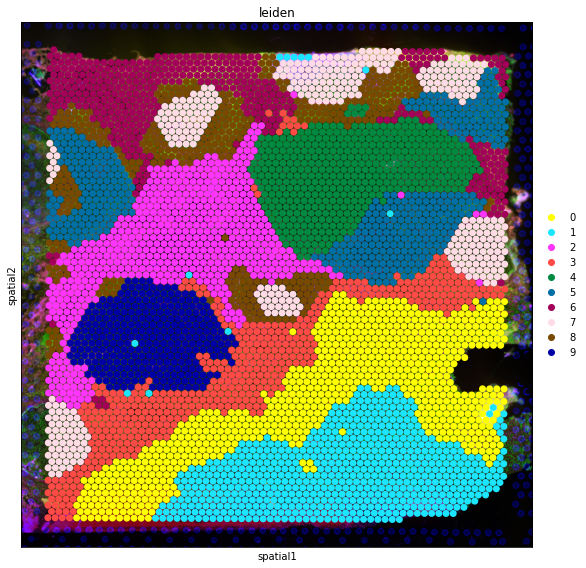
Spatial domain identification#
We identify spatial domains using the relation matrix.
[6]:
sc.tl.leiden(adata, resolution=1.5, neighbors_key='relation')
[7]:
fig, axs = plt.subplots(figsize=(8, 8))

sc.pl.spatial(
    adata,
    img_key='hires',
    color='leiden',
    size=1.5,
    palette=sc.pl.palettes.default_102,
    legend_loc='right margin',
    show=False,
    ax=axs,
)

plt.tight_layout()
... storing 'feature_types' as categorical
... storing 'genome' as categorical
Spatial domain annotation#
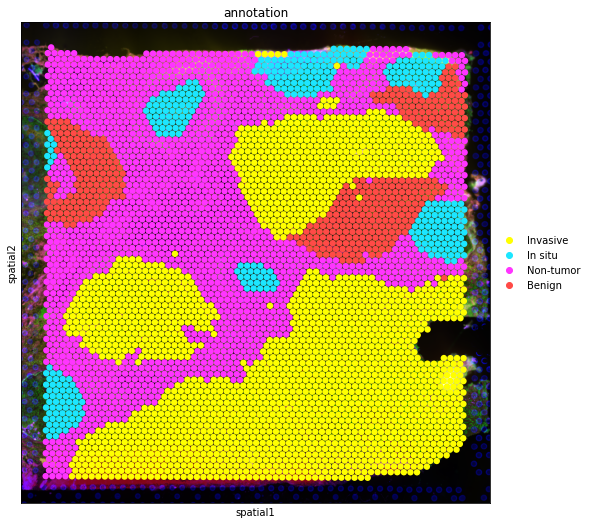
We annotate the spatial domains based on the pathologist annotation from Zhao, E. et al.
[8]:
map_dict = {
    '0': 'Invasive',
    '1': 'Invasive',
    '2': 'Non-tumor',
    '3': 'Non-tumor',
    '4': 'Invasive',
    '5': 'Benign',
    '6': 'Non-tumor',
    '7': 'In situ',
    '8': 'Non-tumor',
    '9': 'Invasive',
}
[9]:
adata.obs['annotation'] = pd.Categorical(
    adata.obs['leiden'].map(map_dict),
    categories=['Invasive', 'In situ', 'Non-tumor', 'Benign']
)
[10]:
fig, axs = plt.subplots(figsize=(8, 8))

sc.pl.spatial(
    adata,
    img_key='hires',
    color='annotation',
    size=1.5,
    palette=sc.pl.palettes.default_102,
    legend_loc='right margin',
    show=False,
    ax=axs,
)

plt.tight_layout()
Finding differentially expressed genes#
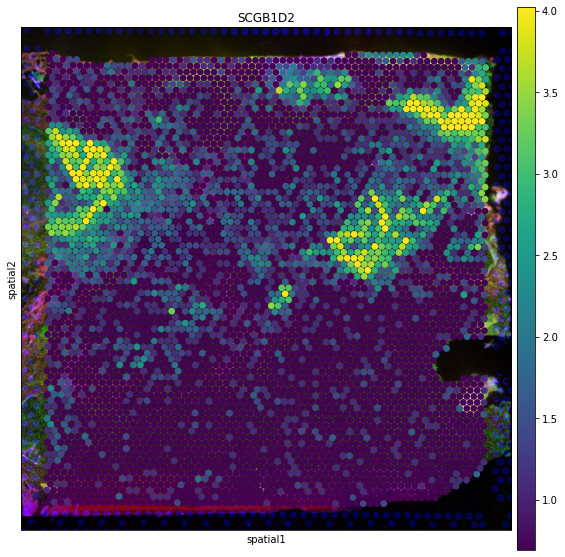
We find the differentially expressed (DE) genes across identified domains and show their expression patterns in spatial coordinates.
[11]:
sc.tl.rank_genes_groups(adata, groupby='leiden', use_raw=False, layer='counts', method='t-test')
[12]:
de_genes = pd.DataFrame(adata.uns['rank_genes_groups']['names']).iloc[:10,:]
de_genes
[12]:
| 0 | 1 | 2 | 3 | 4 | 5 | 6 | 7 | 8 | 9 | |
|---|---|---|---|---|---|---|---|---|---|---|
| 0 | MUC1 | CXCL14 | MT-CO2 | CD74 | SLC39A6 | SCGB1D2 | MALAT1 | MGP | IGKC | IFI6 |
| 1 | CXCL14 | GALNT6 | MT-ND1 | APOE | ZNF703 | SCGB2A2 | CCDC80 | H2AFJ | IGHG3 | RPL30 |
| 2 | TCEAL4 | SPP1 | MT-ND2 | C1QB | CFB | CSTA | ANKRD12 | SNHG25 | IGHG4 | RPL19 |
| 3 | CCND1 | MUC1 | IGHG3 | C1QA | BAMBI | S100G | IGKC | TFF3 | IGLC2 | NME2 |
| 4 | TTLL12 | COL1A2 | IGKC | TIMP1 | MUC5B | ADIRF | ATRX | ERLIN2 | C3 | HLA-B |
| 5 | KRT8 | DNAJC1 | MT-ND4 | HLA-DRA | TMEM150C | MGP | SAMHD1 | COPS9 | IGHG1 | NQO1 |
| 6 | GALNT6 | TCEAL4 | IGLC2 | FTL | RPS18 | H2AFJ | FYB1 | ZNF703 | IGHA1 | KRT19 |
| 7 | KRT18 | ATP9A | MT-ATP6 | BGN | TNFSF10 | HEBP1 | HSP90B1 | SLC9A3R1 | C1QA | LGALS3BP |
| 8 | DEGS2 | VEGFA | MT-ND5 | HLA-DPB1 | IGFBP5 | FAM234B | CALD1 | TOB1 | IGLC1 | BAMBI |
| 9 | AGR2 | PRRC2C | MT-CO1 | CTSD | XBP1 | HLA-A | BOD1L1 | ACTG1 | JCHAIN | HLA-A |
[13]:
fig, axs = plt.subplots(figsize=(8, 8))

sc.pl.spatial(
    adata,
    img_key='hires',
    color=de_genes.iloc[0,5],
    layer='log1p',
    size=1.5,
    palette=sc.pl.palettes.default_102,
    legend_loc='right margin',
    vmin='p50',
    vmax='p99',
    show=False,
    ax=axs,
)

plt.tight_layout()
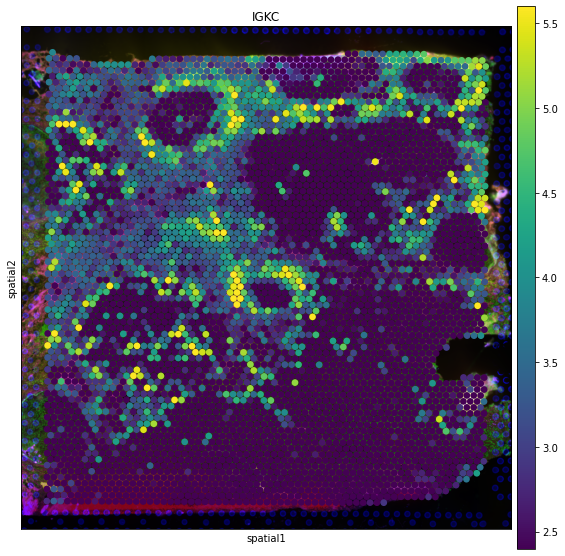
[14]:
fig, axs = plt.subplots(figsize=(8, 8))

sc.pl.spatial(
    adata,
    img_key='hires',
    color=de_genes.iloc[0,8],
    layer='log1p',
    size=1.5,
    palette=sc.pl.palettes.default_102,
    legend_loc='right margin',
    vmin='p50',
    vmax='p99',
    show=False,
    ax=axs,
)

plt.tight_layout()